 / blog
PostgresEDI September 2026 Meetup Recap: tiering to Iceberg, and Postgres from Nuxt
Last week we had our September PostgresEDI meetup, the first since postgres.scot went up as the home for Postgres events in Scotland.
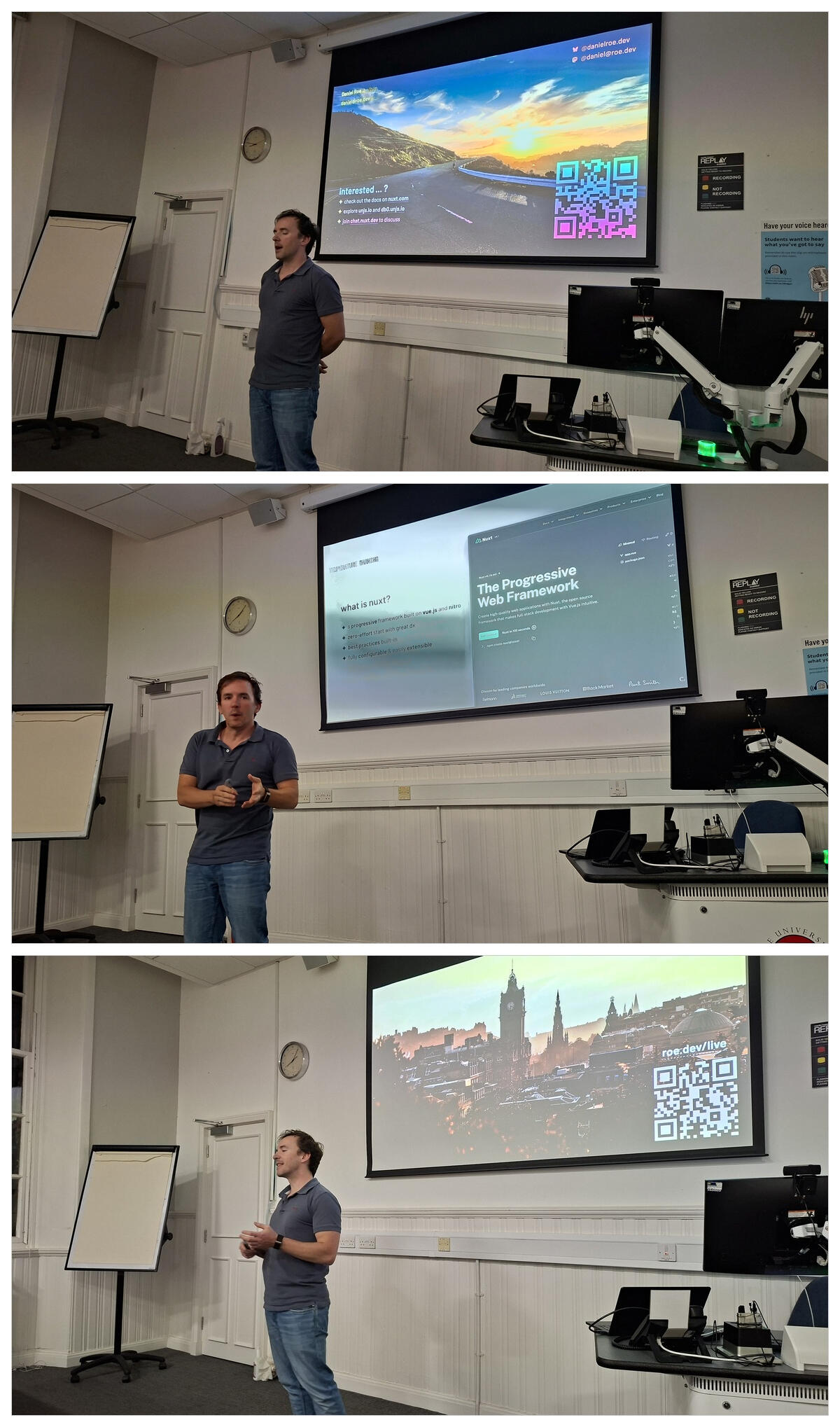
Thursday, September 24th took us back to Paterson's Land at the University of Edinburgh, room 1.27 this time, for two talks that could hardly have come at the subject from further apart. Thanks to everyone who came along, to Daniel for joining us from a different corner of the software world, and to pgEdge for the pizza and refreshments. Special thanks to the friend who came all the way down from Aberdeen for the evening, which is a serious commitment for a Thursday.
The Talks
ColdFront: Transparent PostgreSQL Data Tiering to Apache Iceberg
Jimmy Angelakos (pgEdge)
First up was my own talk on ColdFront, which moves cold rows out of Postgres onto object storage as Apache Iceberg tables in columnar Parquet, and keeps them readable from Postgres as though they had never gone anywhere. The design is deliberately slim: Postgres holds your tables and your SQL, pg_duckdb does the Iceberg reading and writing in-process, Lakekeeper is the catalog, and the object store is whichever one you already have. Your application goes on querying one relation.
The hard part is what happens when the cold tier is writable and several Postgres nodes are writing to it, with a single Iceberg catalog and a single bucket between them. ColdFront takes a ticket before each cold write so that two writers never collide in the first place, and we modelled that protocol in TLA+ rather than trusting our intuition for it.
I closed with vector search over cold data, where a probe comes down to a WHERE clause with no index to build.
📊 View the slides: ColdFront: Transparent PostgreSQL Data Tiering to Apache Iceberg (PDF)
Working with Postgres in Nuxt (including live coding!)
Daniel Roe
After the break, Daniel Roe, who leads the Nuxt core team and works on it full-time at Vercel, showed us what Postgres looks like from the far end of the stack.
He started with what Nuxt actually is, which is a progressive framework built on Vue.js and Nitro. From there he worked downwards, through UnJS and Nitro to db0, a lightweight SQL connector that puts one API in front of many drivers and parameterises your queries for you. Postgres is one of those drivers, and by the end he was live-coding an endpoint against it.
The second half widened out into how open source actually gets built: aiming for progressive adoption so that a project is discoverable, incrementally adoptable and backwards-compatible, taking care not to become the bottleneck yourself, and his case for the 10x team, being people who care about the same problem, iterate together and make each other better.
📊 View the slides: from zero to postgres: nuxt, unjs & db0 (PDF)
Having a speaker from outside the Postgres community was very refreshing, with different perspectives and more insight into what we do than we tend to get among ourselves. This is something we very much welcome.
What's Next?
ColdFront is in London next week, if you are nearer there than here. I am giving a short talk on it at the London PostgreSQL Meetup Group on Wednesday, October 7th, and again at the Apache Iceberg Europe meetup on Thursday, October 8th. Do say hello if you are at either!
Our next meetup is on Thursday, October 15th, when Elizabeth Garrett Christensen of Snowflake joins us to go over what is arriving in Postgres 19, along with the parts of 18 that went by unnoticed. Same building, room 1.21, doors at 18:00.
RSVP here: 👇
The second October slot is still open, and first-time speakers are especially welcome. Anything Postgres-related, at any length and any level of polish: drop us an email at info (at) postgres.scot.
Make sure you are following us for updates:
- Events in Scotland: postgres.scot
- LinkedIn: linkedin.com/company/postgresedi
- Mastodon: @PostgresEDI@fosstodon.org
- Bluesky: @postgresedi.bsky.social
Thanks again to Daniel, and to the UoE for having us. See you on October 15th! 🍕