 / blog
postgres.scot November 2026: a live Radar demo and Call for Presentations for December meetup
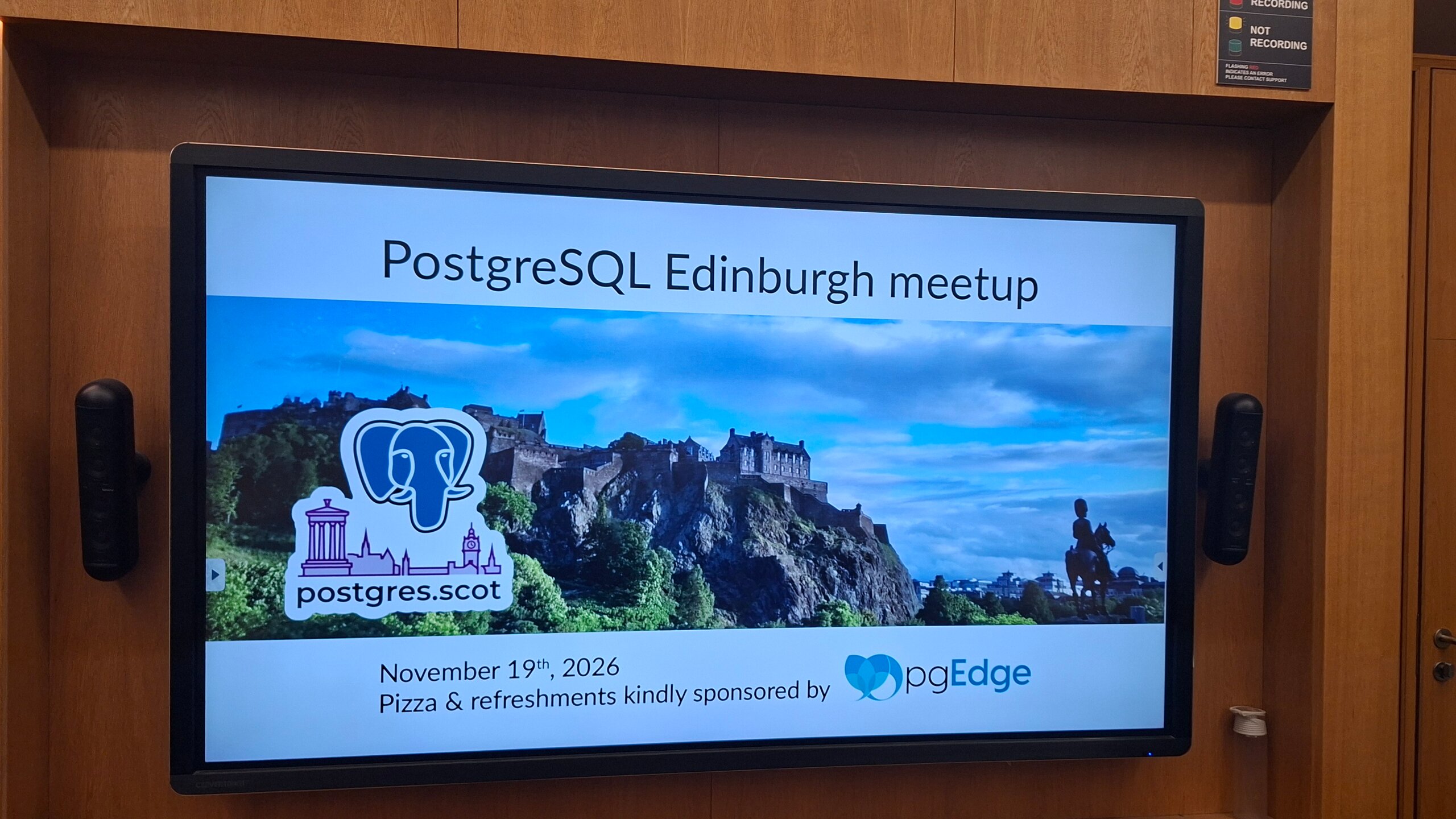
Yesterday, Thursday, November 19th, was a cold night in Edinburgh, but the wonderful Law School in the University of Edinburgh's Old College was warm and cosy for our November meetup.
We were a speaker short, though. Alastair Turner of Percona was on his way to Edinburgh when his train turned back, because an incident on the line had cancelled all northbound trains for several hours, and there was no other way for him to get here in time. Alastair spoke at our February meetup, and we were very sorry not to see him again, or to discuss his topic with him in person.
Radar + Radar Analyst, expanded and live
So I stepped in with an expanded version of the talk I gave at PGConf.EU last month, Radar + Radar Analyst: Agentless Diagnostic Snapshots for PostgreSQL, and a live demo. In the demo, radar collected a diagnostic snapshot from my personal server (which, slightly embarrassingly, is sub-optimally configured in some places), and radar-analyst turned it into an expert-level analysis as we watched.
If you haven't come across them yet, radar is a single Go binary that you run when something is wrong. In a few seconds, it gathers the configuration, statistics and host details that a support engineer would otherwise ask for one email at a time, writes them into a zipfile and exits. radar-analyst then checks that zipfile against a set of deterministic rules, and each finding comes with the fix for it. It can also ask an LLM to write a brief on top, but whatever the model says, a verdict can never be milder than the worst finding behind it. Both tools are released under the PostgreSQL Licence, and contributions of new rules are welcome.
📊 Slides: Radar + Radar Analyst: Agentless Diagnostic Snapshots for PostgreSQL (PDF)
Alastair's talk, on video
After a short break, and with Alastair's permission, we sat down to watch a recording of an earlier version of his talk, Gravity Wells and Guidebooks: AI Application Architecture by Analogy, from BuildDevCon's Building AI Apps with PostgreSQL event.
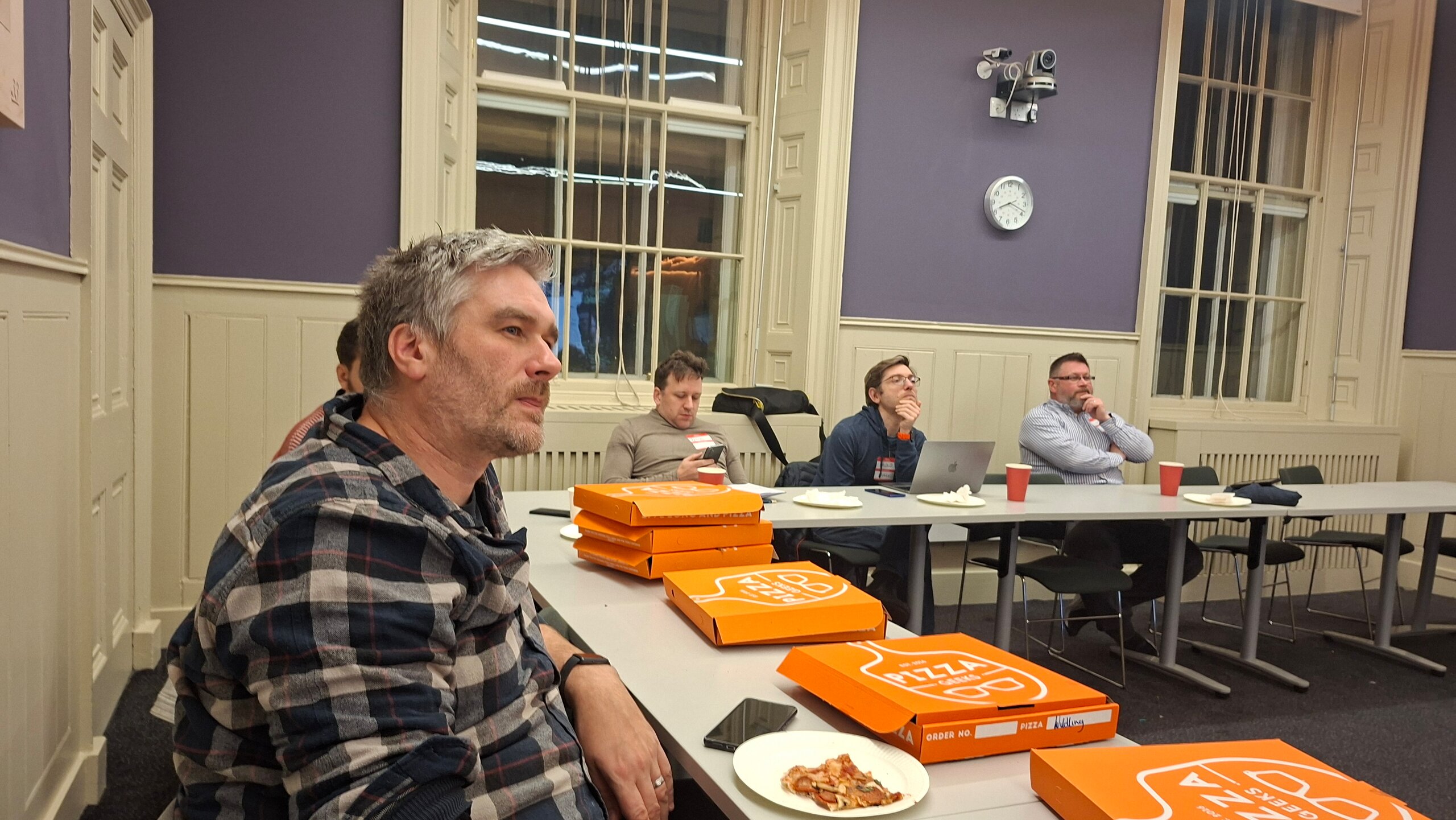 Watching Alastair's talk after the break
It is certainly not the same as having him there to present it, but he brought up some great points about designing AI applications with Postgres, as things stand now and as they develop, and went into technical detail that was new to many in the audience.
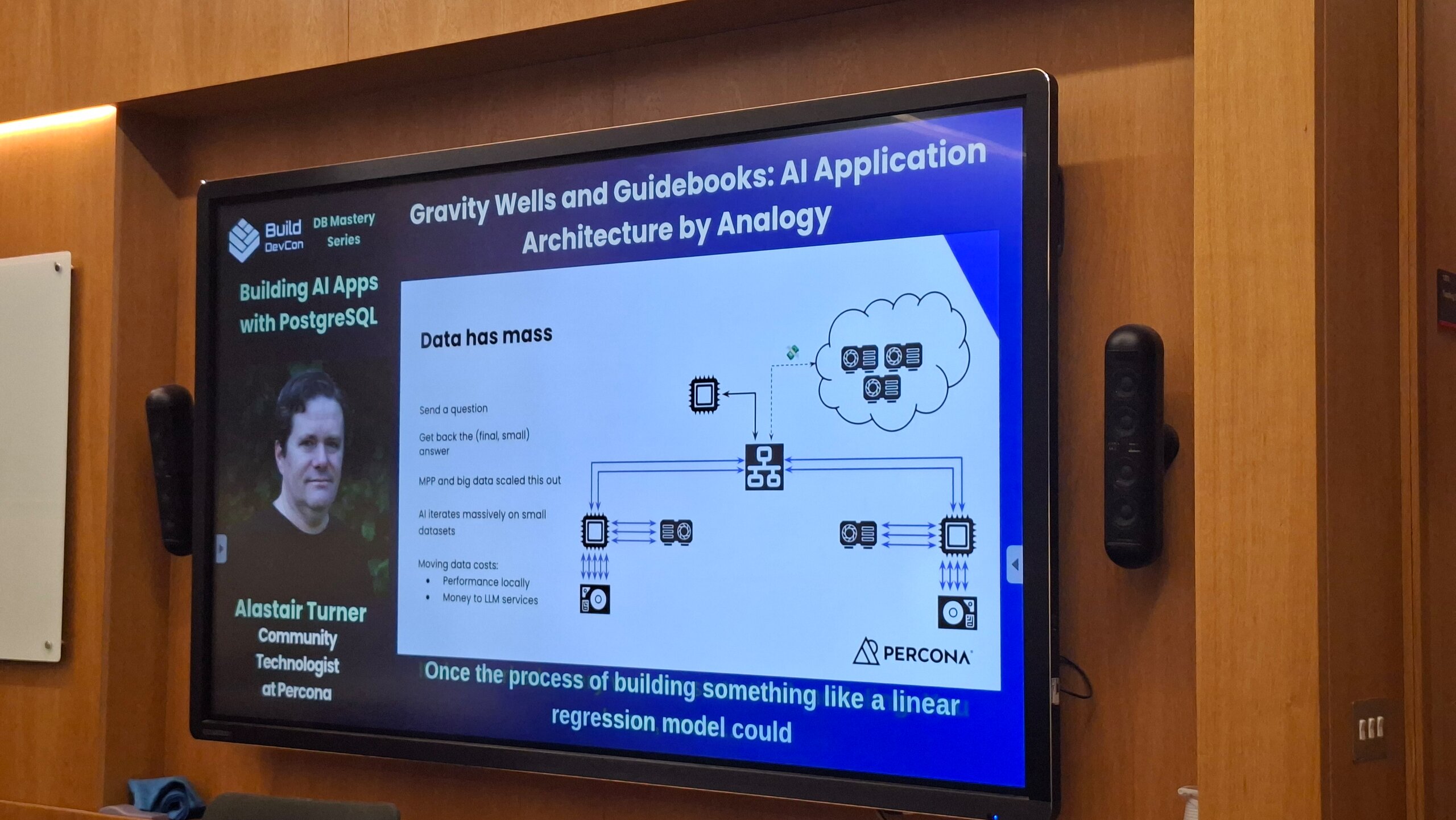 Data has mass: the first of Alastair's analogies
Alastair looked at which lessons from earlier efforts to drive value from data apply to AI applications on Postgres, and which don't, starting with the positioning of the data and the query engine. Data has mass, so massively parallel databases and big data infrastructure sent the work to the data and returned a small answer. An LLM is almost never on the same machine as the database, and a hosted one charges for every token, so the aim is still a good SQL query that sends the model only a small final answer, rather than moving the model closer to the raw data. From there he went through scanning small sets of embeddings in pgvector without an index, partitioning so that each partition gets its own smaller vector index, giving every user their own access in the database, the churn of short-lived psql connections, semantic layers for generating queries, and handling high-churn work, such as queues, without bloat.
🎞️ Recording on YouTube: youtube.com/watch?v=ZJzZG05xCeQ
Thanks to Alastair for letting us show it, to pgEdge for sponsoring the pizza and refreshments, and to everyone who joined us on Thursday.
Call for Presentations: Thursday, December 10th
Our last meetup of 2026 is on Thursday, December 10th, at the University of Edinburgh, and both talk slots 🎤 are still open. If you'd like to give a talk but can't decide what about, here are three titles, ready for you to fill in:
- The Postgres feature I wish I'd found sooner: _____
- _____ broke in production. Here's how we worked out why.
- Everyone was telling me to try _____ : this is what I learned.
First talks and short talks are very welcome. If you'd rather listen this time, you can RSVP on cloomba. If you'd like one of those slots, email us at info (at) postgres.scot, or message postgres.scot on Mastodon, Bluesky or LinkedIn!