 / blog
PGConf.EU 2026 MEGAPOST: a busy week in Valencia
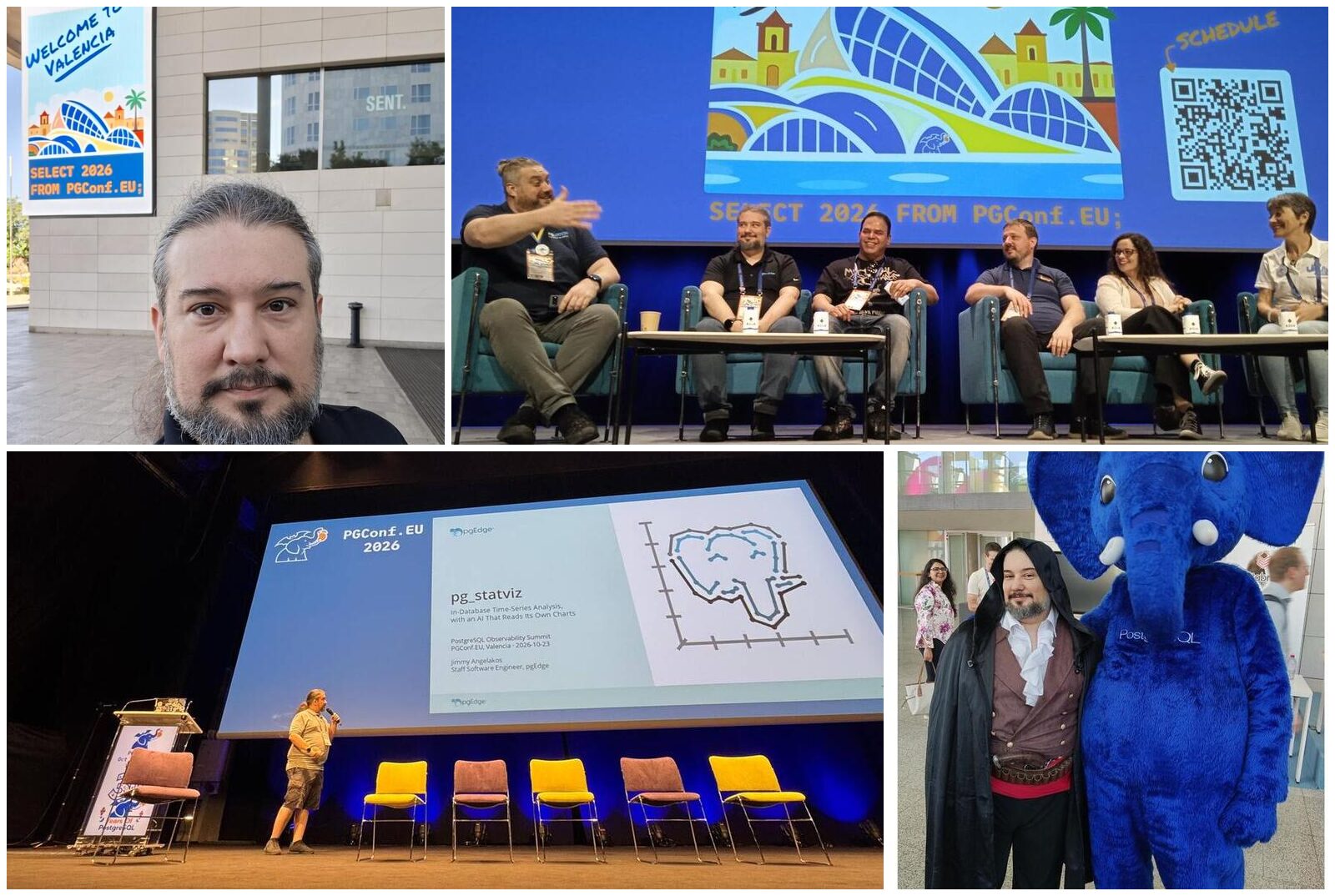
This year's PostgreSQL Conference Europe, PGConf.EU 2026, took place from October 20th to 23rd in wonderful Valencia, at the Palacio de Congresos. There was far too much going on to cover it all, so I'm just going to go over what I was involved with: a panel on Tuesday, a book signing on Wednesday, a talk on Thursday, and three Community Events on Friday. That still leaves out the hallway track, and the many discussions there on everything from Postgres heisenbugs to the core development workflow to community building.
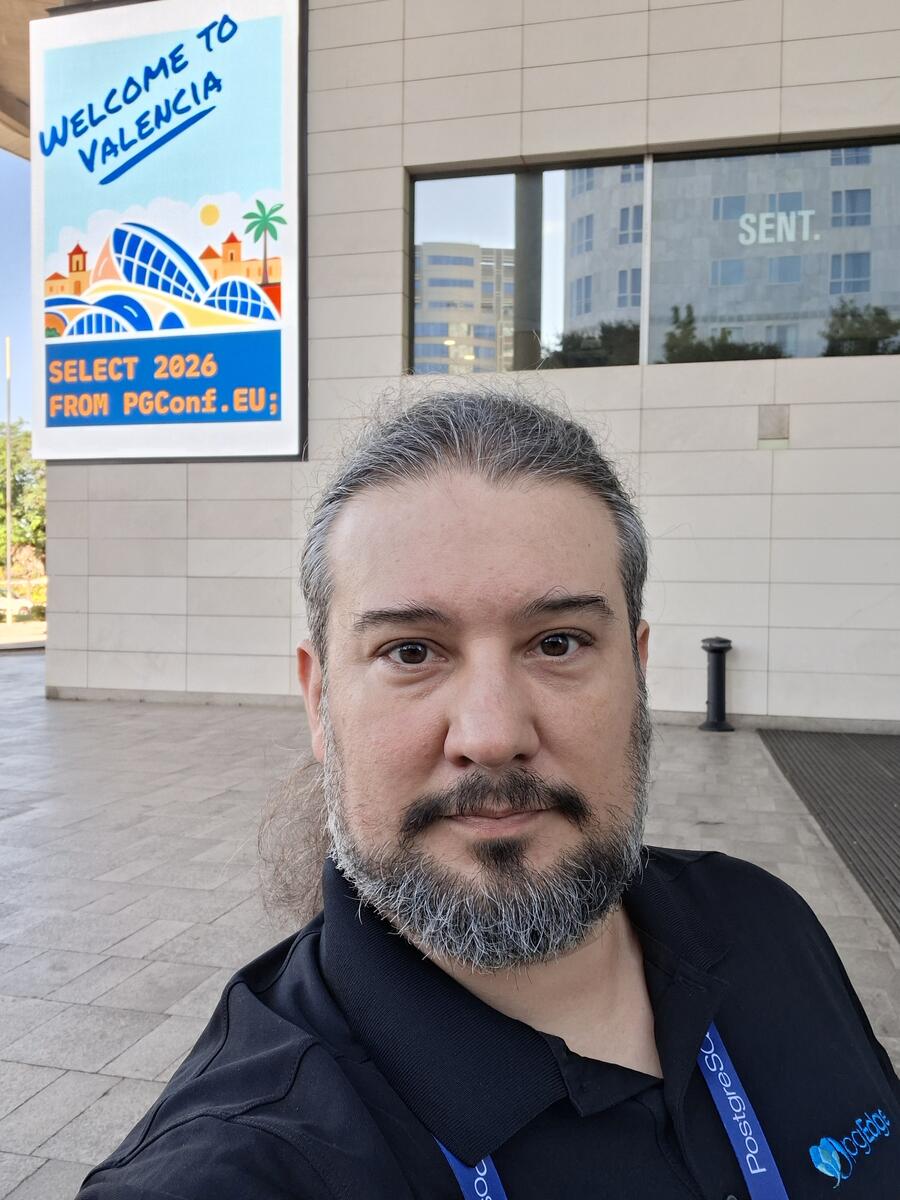 Obligatory selfie from PGConf.EU 2026
The panel: Postgres On-Call Confessions
On Tuesday afternoon I joined Ants Aasma, Mayuresh Bagayatkar, Hettie Dombrovskaya, Pavlo Golub and Teresa Lopes for Postgres On-Call Confessions: Worst Practices 101, a panel on the "Postgres in production" topics everyone shies away from. We started with the common threads in where we've seen Postgres fail at scale and in production, but also the most embarrassing and funniest incidents each of us has personally witnessed. Then the mic was open for anyone in the audience to come up and confess an "obvious fix" of their own that backfired in production.
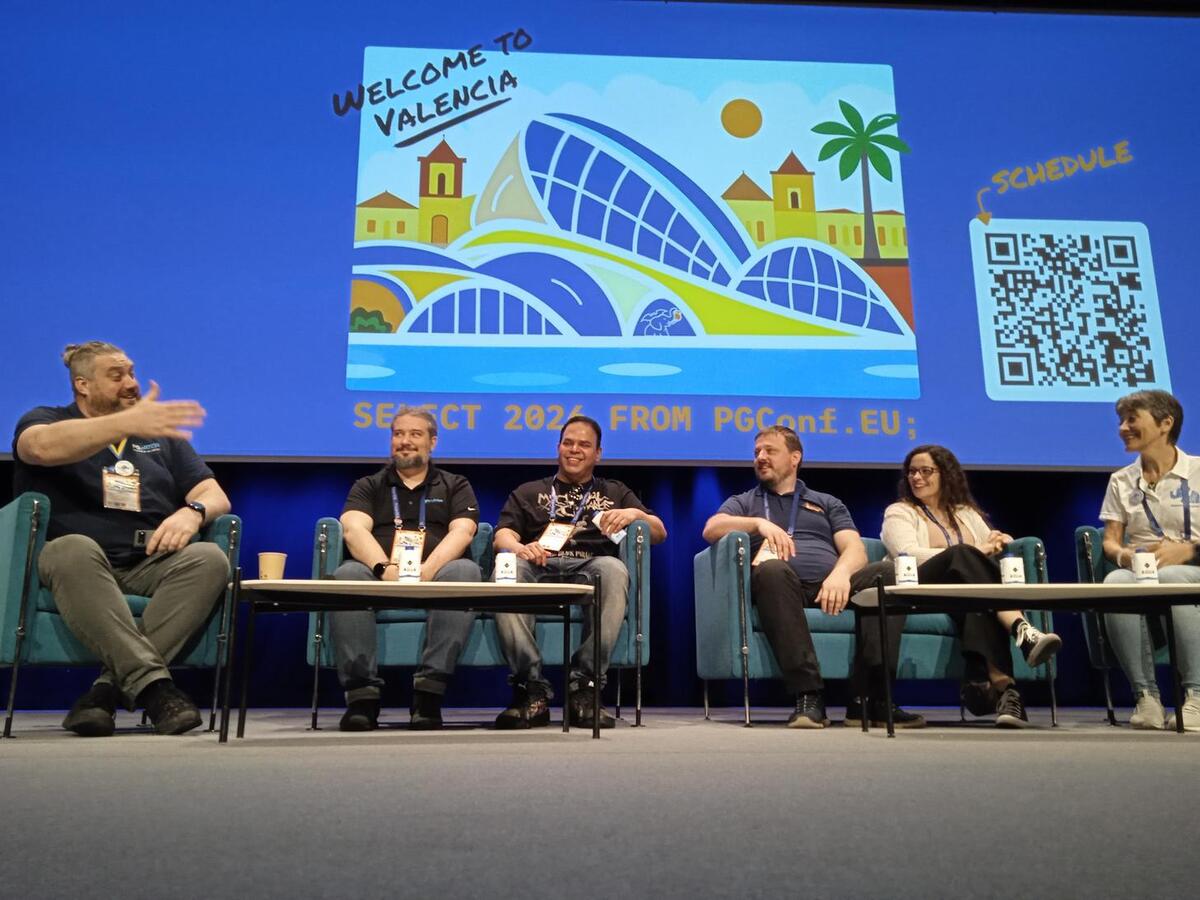 The Postgres On-Call Confessions panel, left to right: Pavlo Golub, me, Mayuresh Bagayatkar, Ants Aasma, Teresa Lopes and Hettie Dombrovskaya
The talk: radar + radar-analyst
On Thursday morning I had the pleasure of presenting radar + radar-analyst: Agentless Diagnostic Snapshots for PostgreSQL.
The starting point is familiar to anyone who has worked in support. A monitoring agent only helps if it was already running before things went wrong, the Postgres log only shows what your queries did, and the rest of the picture takes a dozen emails back and forth. radar is a single static Go binary that collects a snapshot of PostgreSQL and the host it runs on into one zipfile, in seconds, and then exits. It collects metadata only (catalogs, statistics and configuration), and never row data or passwords.
radar-analyst is what you do with that zipfile. It runs a pack of deterministic rules over the archive, gives each category a verdict, and pairs every finding with a fix. An LLM can optionally write a brief on top, the way a senior DBA would, but only the rules can create a finding, and the model can never soften the verdict they arrive at.
Both are open source under the PostgreSQL Licence.
📊 View the slides: radar + radar-analyst: Agentless Diagnostic Snapshots for PostgreSQL (PDF)
Community Events Day
Friday was the Community Events Day, and somehow I was involved in three of the (half-day) events!
PostgreSQL Observability Summit
The day began with the PostgreSQL Observability Summit, which I co-organised with Lukas Fittl, Pavlo Golub, Adrien Obernesser and Gülçin Yıldırım Jelínek. It was a packed morning of short talks, followed by a panel discussion moderated by Pavlo.
My own talk, after embarrassingly battling with my laptop, which decided to perform an uninterruptible UEFI BIOS update upon boot, was pg_statviz: In-Database Time-Series Analysis, with an AI That Reads Its Own Charts. pg_statviz takes snapshots of the cumulative statistics PostgreSQL already keeps and stores them in tables in the same database, which turns them into time series you can chart, keep and query, without an agent or an exporter. The optional AI part hands the charts themselves to a vision-capable LLM, because the chart is what a DBA actually reads, and as with radar-analyst, the deterministic rules have the final say on the verdict.
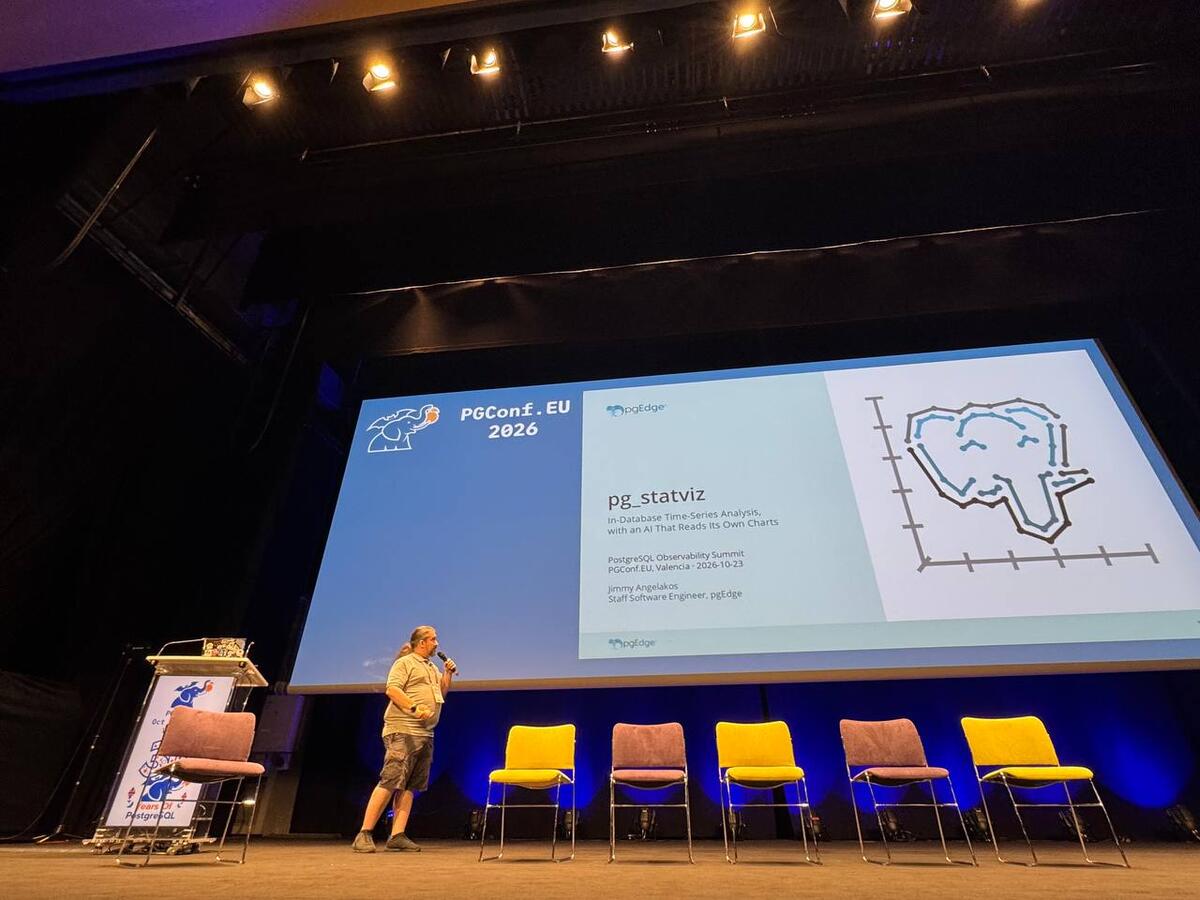 Presenting pg_statviz at the Observability Summit
📊 View the slides: pg_statviz: In-Database Time-Series Analysis, with an AI That Reads Its Own Charts (PDF)
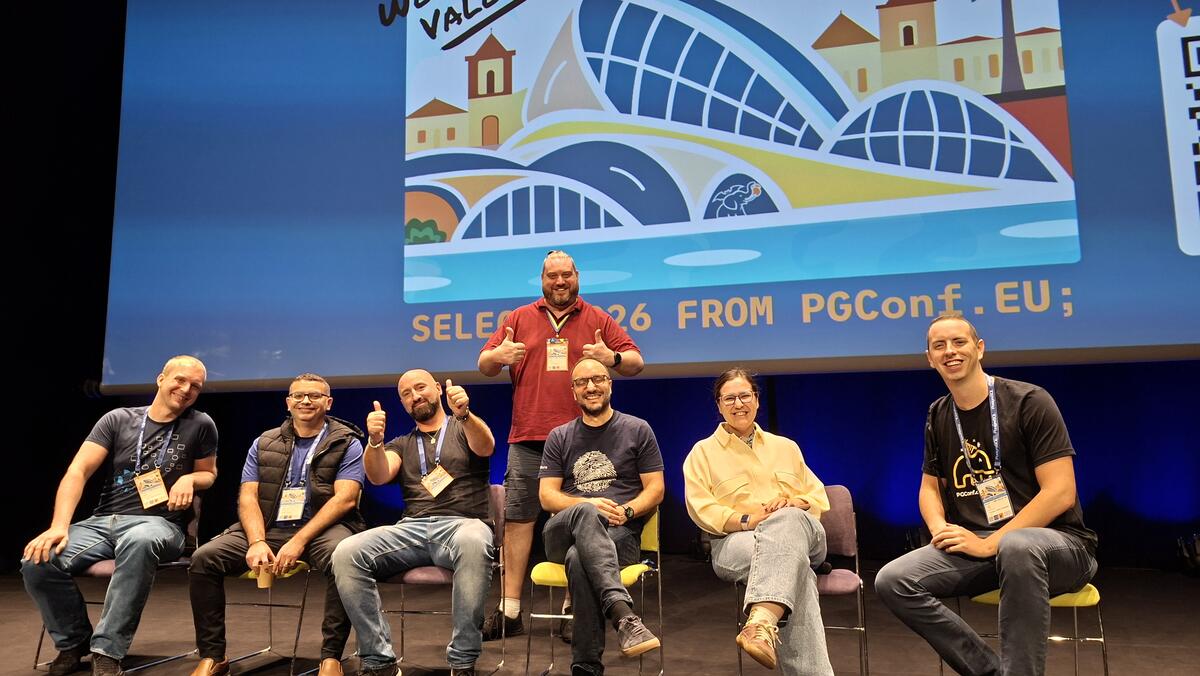 The Observability Summit panel, left to right: Lukas Fittl, Sami Imseih, Bertrand Drouvot, Luigi Nardi, Gülçin Yıldırım Jelínek and Tristan Partin, with moderator Pavlo Golub in the background
The wiki page for the summit has the full schedule, the slides from the other talks, and a summary of the panel discussion.
PostgreSQL Training Materials Working Group
In the afternoon, Hettie and I ran the PostgreSQL Training Materials Working Group. The question behind it was how to make Postgres very easy to start with for casual developers, students and other newcomers, because our documentation serves professionals very well, but our onboarding for beginners is lacking.
It was a wildly productive session. We started with a live demo of postgresql.org from the perspective of a total newcomer to Postgres, and it did not go well for the website: there is no "getting started" button, it took 14 clicks to find where to start, then another 7 on the download page to get to something you can copy and paste on Linux, with no detection of which operating system you are on, there is no sandbox to try Postgres in if your laptop is locked down, the first psql fails on pg_hba.conf, and then you are asked to create a database without being told why. We then sorted the training material that already exists, from the official tutorial to third-party courses, exercise sites and sandboxes, and concluded that we can link to all of it, with no need to adopt any one of them. In between, the participants worked out an ideal onboarding workflow and what a minimal tutorial should contain and in which order, starting from the concept of what you are building, and adding data before any other DML. Many thanks to all of them!
The full notes, including the list of materials we reviewed and the tutorial outline, are on the wiki page for the working group.
New PostgreSQL Community Members Summit
At the New PostgreSQL Community Members Summit, organised by Cornelia Biacsics and Andreas Scherbaum, Charis Charalampidi and I presented Zero to PUG: A Playbook for New Community Builders.
Charis's part is about the Greece PostgreSQL Users Group: the work behind each meetup, from finding sponsors and speakers to leading a volunteer team alongside the day job, what makes the effort worthwhile, and the many ways people can take part. You can watch her talk below.
🎞️ Video on YouTube: youtube.com/watch?v=_uzlZN3Ohps
📊 View Charis's slides: Zero to PUG: A Playbook for New Community Builders (PDF)
My part was about the first year of organising PostgresEDI, the PostgreSQL Edinburgh User Group, which you can find at postgres.scot: what you need to get started, what has gone well, and what is still hard, with finding speakers every month at the top of the list.
📊 View my slides: Organising PostgresEDI: One year of running the PostgreSQL Edinburgh User Group (PDF)
PG Karaoke
Friday ended at PG Karaoke, organised by Floor Drees, and there is photographic evidence of Boriss Mejías and me on stage.
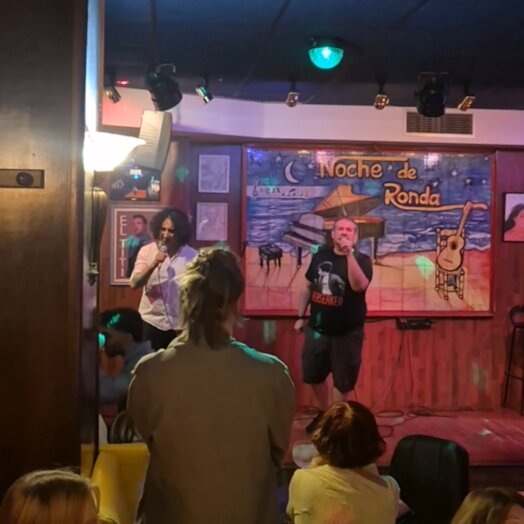 Boriss Mejías and me at PG Karaoke
Book signing
On Wednesday, during the lunch break, I signed copies of my book, PostgreSQL Mistakes and How to Avoid Them, at the pgEdge table, cosplaying as the character from its cover, and was even captured in the same frame together with a wild Slonik.
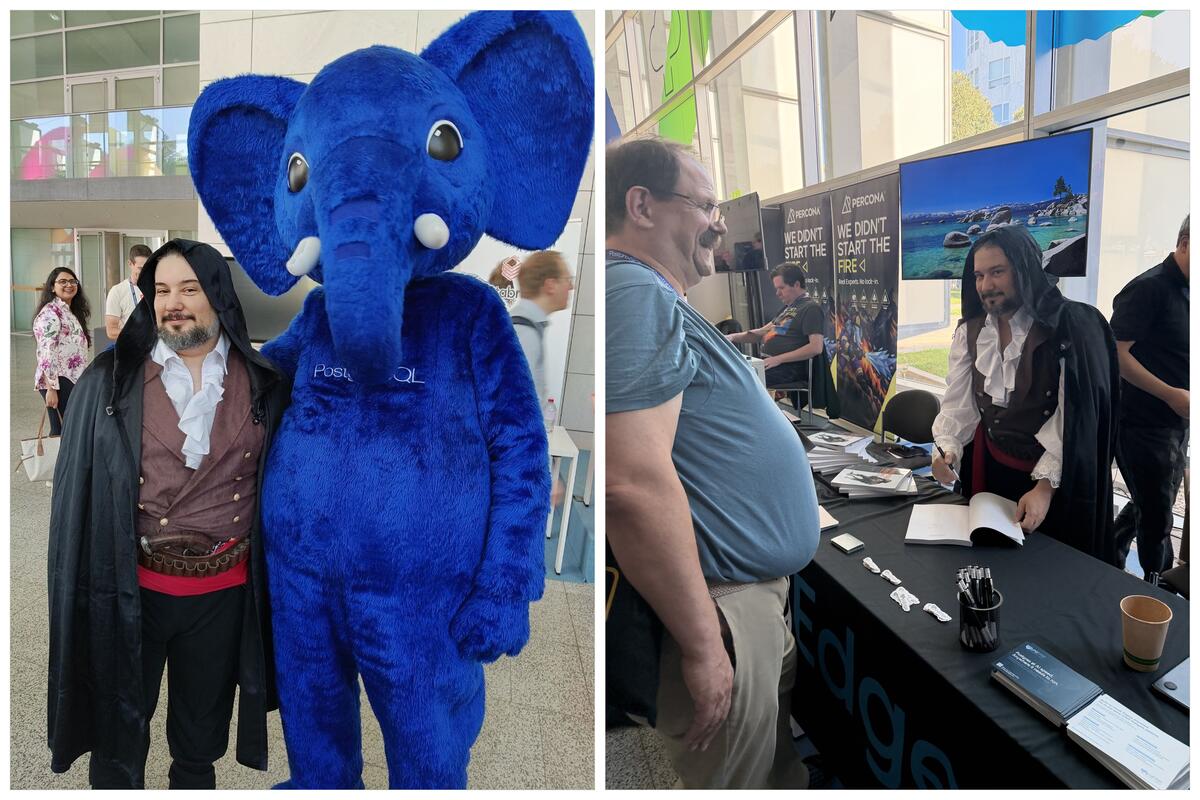 Obligatory Slonik photo, and the signing at the pgEdge table
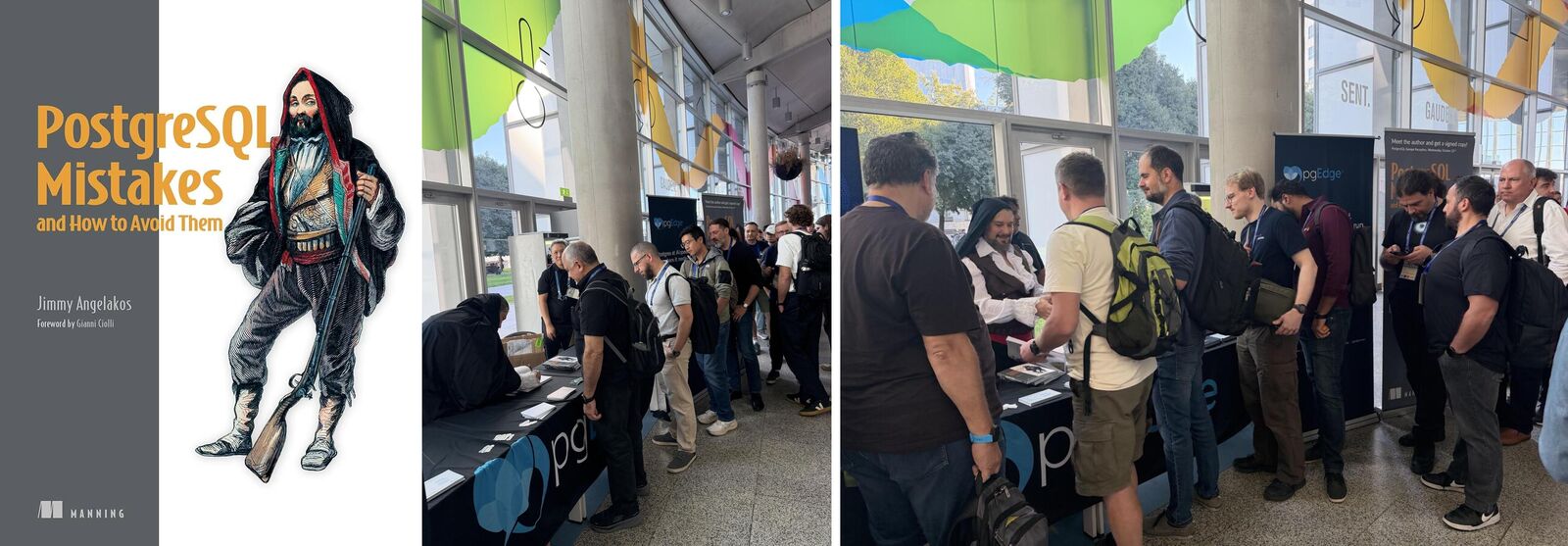 The book, and the queue for signed copies at the pgEdge table
A huge thank you to pgEdge and Manning Publications for investing in long-form technical education and real-world engineering expertise, and to everyone who came by to say hi! If you couldn't be there, the code au35ang gives you 35% off the book, or anything else on manning.com.
PostgreSQL Europe Diversity Committee
I am also a member of the PostgreSQL Europe Diversity Committee, chaired by Karen Jex, with Cornelia Biacsics, Floor Drees, José Antonio Morcillo Valenciano, Martins Otun and Stefanie Janine Stölting, and Stacey Haysler as our advisor. At the conference this year that meant Hidden Disabilities Sunflower support, the Community Celebration Board, now with badge making, the Postgres Women+ Breakfast, a quiet room to rest and decompress in, and, new this year, Conference Bingo.
Karen gave a short presentation of the committee's work during the New PostgreSQL Community Members Summit on the Community Events Day. The slides, with a transcript, are on her blog. Many thanks to my fellow committee members!
And many thanks to everyone who made PGConf.EU 2026 possible:
- the Organising Committee: Chris Ellis, Stefan Fercot, Magnus Hagander, Karen Jex, Valeria Kaplan, Ilya Kosmodemiansky, Marc Linster, Martín Marqués, Dave Page, Andreas Scherbaum and Samed Yildirim;
- the Talk Selection Committee: Mayuresh Bagayatkar, Priyanka Chatterjee, Floor Drees, Jan Karremans, Andrei Lepikhov, Stefanie Janine Stölting, Jan Wieremjewicz and Gülçin Yıldırım Jelínek, chaired by Samed Yildirim;
- the Code of Conduct Committee: Pavlo Golub, Stacey Haysler, Ellyne Phneah and Samed Yildirim;
- and all the volunteers, who kept the conference running smoothly.
Everyone who helped out, including all the volunteers by name, is listed on postgres-contrib.org. Thanks also to the speakers, the sponsors, and everyone who came along to any of these sessions. See you at the next Postgres event!